Dr Mara Clarson
Breast Surgery
Personalised breast surgery care, with guidance and support at every step of your journey.
Sunshine Coast-Based Specialist Breast & Endocrine General Surgeon
Dr Mara Clarson
Dr Mara Clarson
A Personalised Approach to Breast Surgery
Dr Mara Clarson is dedicated to providing gold-standard, personalised care for women and men requiring surgical treatment of breast conditions.
Together with a trusted multidisciplinary team, Dr Clarson guides her patients through their breast surgery journey with experience, knowledge and compassion.
Dr Mara Clarson
Breast Conditions We Treat
Dr Clarson welcomes referrals for both benign and malignant breast conditions.
Breast cancer and precancerous breast conditions
- Female and male breast cancer
- Papillary lesions with atypia
- Prophylactic mastectomy for heritable cancer risk
- Reconstruction following mastectomy
- Dr Clarson also works in conjunction with plastic surgeons to achieve the best outcomes.
Dr Clarson employs advanced oncoplastic techniques to achieve optimal cancer outcomes while also prioritising preservation of breast appearance and long-term quality of life.
Benign breast conditions
- Fibroadenoma
- Papillary lesions
- Phyllodes tumours
- Symptomatic macromastia (for therapeutic breast reduction)
- Gynaecomastia
- Removal of breast implants
Dr Clarson respectfully declines any referrals for cosmetic breast surgery.
Every patient's circumstances are unique.
If you have a breast condition that is not listed above, please contact Dr Clarson’s rooms for further guidance
Dr Mara Clarson
Breast Surgery Procedures
Dr Clarson provides a range of breast surgery procedures, from breast-conserving surgery and mastectomy through to lymph node procedures and breast reconstruction. Each approach is carefully considered to achieve the best possible outcome for your individual circumstances.
Breast reduction surgery
Breast reduction surgery (also known as reduction mammoplasty) is an operation to remove extra fat, tissue, and skin from your breasts. You might consider it if you have very large breasts (also known as macromastia or gigantomastia) that are causing neck pain, back pain, or other symptoms.
Breast-conserving cancer surgery
- Wide local excision / lumpectomyA lumpectomy, or wide local excision, is performed to remove a cancerous tumor from the breast while leaving as much normal breast tissue intact as possible.
- Breast reduction (therapeutic mammoplasty)Breast reduction can be integrated into cancer treatment, through an oncoplastic or therapeutic mammoplasty. This approach combines removal of the breast cancer with breast reduction techniques. This allows removal of cancerous tissue while simultaneously reducing breast size and improving symmetry. It can also make radiotherapy easier in some cases.
Mastectomy – prophylactic and therapeutic
- Simple or total mastectomyA simple mastectomy (total mastectomy) removes the entire breast with flat wound closure. This includes your breast tissue, skin, nipple and areola. It also includes the lining over the main chest muscle (pectoralis major), while leaving the muscle itself intact.
- Skin preserving mastectomy A skin-sparing mastectomy is a breast cancer surgery that removes breast tissue, nipple, and areola while preserving most of the breast skin to allow immediate reconstruction.
- Nipple-sparing mastectomyA nipple-sparing mastectomy (NSM) is a surgical procedure in which all breast tissue is removed, but the nipple, areola, and surrounding skin are preserved. This creates a skin envelope that allows for immediate reconstruction, with a more natural look.
Who is suitable for NSM?
- Patients with early-stage breast cancer that is not close to the nipple or areola
- Patients who have small, peripherally located tumors that are not aggressive
- Patients undergoing prophylactic mastectomy due to high breast cancer risk, such as BRCA gene carriers
- Patients who are in good overall health, without conditions that impair healing, such as diabetes, smoking, or certain cardiac or clotting disorders
Patients with large, drooping breasts (breast ptosis), tumors near the nipple, or aggressive cancers may not be suitable candidates.
Partial breast reconstruction
- Sometimes a significant volume of breast tissue needs to be removed to adequately treat a cancer. For women who wish to keep their breast size and shape the same, that tissue needs to be replaced. This can be done by using nearby skin and fat. This aims to maintain a good cosmetic result and avoid possible deformity of the breast after radiotherapy. It is less suitable for very slim patients due to limited donor tissue.
- Lateral Intercostal Artery Perforator (LICAP) FlapThis technique uses tissue from the lateral chest wall, under the arm, to fill the cavity remaining after lumpectomy for tumours located in the outer half of the breast.
- Anterior Intercostal Artery Perforator (AICAP) FlapThis technique uses tissue from below the breast and the upper part of the abdomen as a flap to fill the cavity remaining after a lumpectomy for tumours located in the lower half of the breast.
Breast reconstruction after mastectomy
- Breast reconstruction can be done at the same time as a mastectomy (immediate reconstruction), or it can be done months or years later (delayed reconstruction), depending on the individual patient circumstances and preferences.
- Breast reconstruction can be done using your own tissue (autologous reconstruction) or with implants.
- There is no single operation that suits all patients and the decision about whether to have a reconstruction at all and what type of reconstruction is a very individual one, requiring careful consideration and detailed discussion.
- Dr Clarson performs some implant reconstructions, while for others she may involve a plastic surgeon.
- Autologous reconstruction is always performed by a plastic surgeon.
Sentinel node biopsy
Axillary lymph node dissection
Dr Mara Clarson
Your Breast Surgery Journey
Before Surgery
Initial Consult
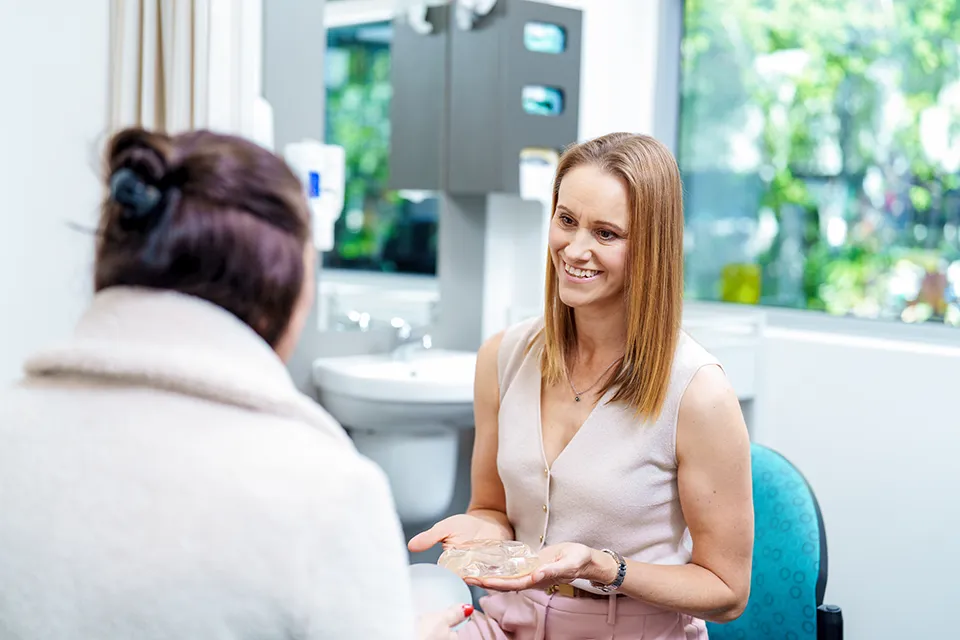
Your initial consult with Dr Clarson will include a discussion of your diagnosis, your thoughts and concerns, relevant medical history, physical examination as required, and a collaborative approach to planning the way forward.
This plan may include a review at a particular time interval, arranging further tests or imaging, referral for multidisciplinary input, and/or proceeding with surgery booking.
The duration of an initial consult is 30 minutes, or 45 minutes for breast cancer patients. If more time is needed, a further appointment will be made.
You are most welcome to bring along a support person to your appointment.
Please bring with you:
- Current medications list
- Any imaging or pathology reports
- Medicare/ DVA card
- Private Health Fund card
- Completed New Patient Registration Form (unless already returned via email)
Some patients may require input from other medical professionals prior to surgery, such as a medical oncologist, radiation oncologist and allied health professionals.
Dr Clarson may request pre-operative blood tests or imaging to assist in surgical planning.
Your Surgery
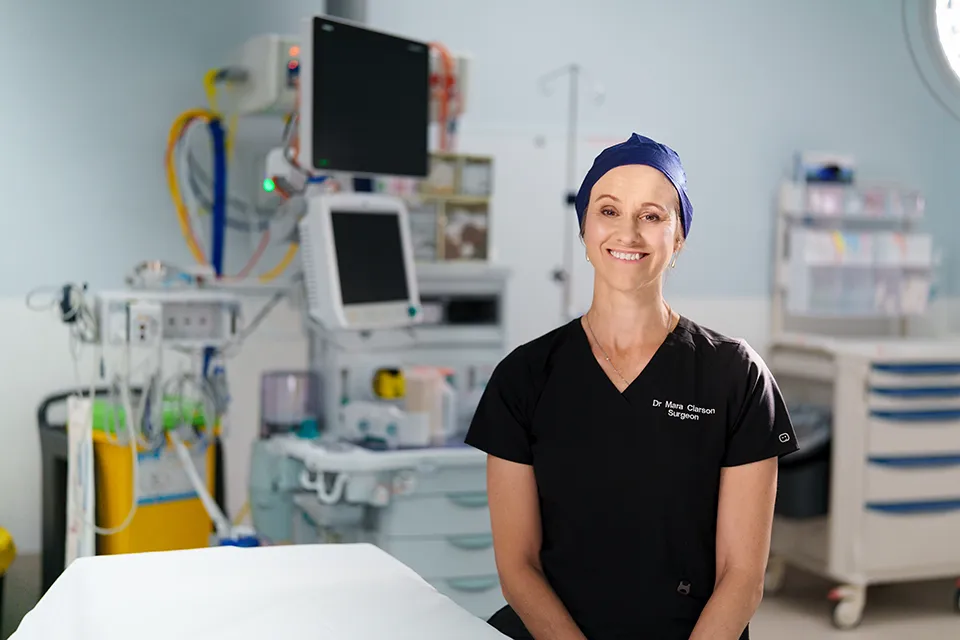
Some patients may require imaging after they have been admitted on the morning of their procedure; they can then wait comfortably on the ward before their surgery.
Our friendly office staff will call the day prior to confirm what time to arrive at the hospital and when to fast.
- Usual fasting time is 6 hours prior to anticipated surgery start time.
- Clear fluids (water, black tea, clear apple juice) are ok up to 2hrs prior to anaesthetic.
- Longer fasting is required for patients on certain medications, such as GLP-1 agonists (e.g. Ozempic, Mounjaro, Trulicity). Please advise our office at your earliest convenience if you are taking any such medications.
What to bring to hospital:
- Comfortable clothes
- Usual toiletries
- Usual medications
- Support garments if having breast surgery
- Phone charger
- Personal medical equipment such as CPAP machine, hearing aids, mobility aids
After your procedure, Dr Clarson will see you on the ward if you are staying overnight to check how you are recovering and answer any questions.
The caring team of nurses and hospital staff are here to help make your recovery as comfortable and smooth as possible.
Recovery & Follow-Up
Depending on the type of surgery, you may or may not be admitted to hospital overnight (anywhere between 1-5 nights).
Dr Clarson reviews all her overnight patients on the ward after their procedure and plans a post-operative review appointment, usually for the following week.
Your expected hospital stay and timeframe for healing and return to regular daily activities can be discussed with Dr Clarson at your appointment prior to surgery.
Medical Certificates are available to Dr Clarson’s patients upon request.
Some patients may require ongoing 6-monthly or annual surveillance with repeat imaging (ultrasound and/or mammogram) under Dr Clarson’s guidance and in keeping with national gold-standard care.
Dr Mara Clarson
Why Choose
Dr Mara Clarson
for Breast Surgery?
Patient-Focused Approach
Dr Clarson’s genuine care and patient-friendly explanations help her patients navigate their health challenges with confidence.
Multidisciplinary Team-Based Care
Dr Clarson works in collaboration with an experienced multidisciplinary team to achieve the best possible outcomes for her patients.
Modern Surgical Techniques
Dr Clarson is committed to delivering modern, high-quality surgical care in a supportive and respectful environment.
Collaborative Care
Dr Clarson maintains close communication with referring general practitioners, other specialists and allied health professionals, providing ongoing updates during and after treatment to ensure a seamless continuum of care for each patient.
Dr Mara Clarson
Resources and Support
Dr Clarson involves a Breast Cancer Nurse, for ongoing support for all her breast cancer patients. Please see McGrath Breast Care Nurse link below.

Dr Clarson regularly refers patients to specialist breast cancer physiotherapist, Jen McKenzie, and the team at The McKenzie Clinic for focussed physiotherapy, particularly relating to breast cancer surgery recovery and lymphoedema management.
Through their Compass Program, The McKenzie clinic also offers excellent support through community and online ‘Preparing for Breast Surgery’ workshops, details of which can be found on their website.

Dr Clarson also refers patients to Megan Oster, Principal Physiotherapist and Founder of Next Wave Cancer Rehab.
Next Wave Cancer Rehab | Oncology Physiotherapy Sunshine Coast

Wondering about a bra for after your mastectomy? Tracey G and her team are experts in fitting and providing the support you need.

Bloomhill Cancer Care offers a wide range of supports to people facing a cancer diagnosis and treatment. Patients are welcome to self-refer to access Bloomhill’s services.
Hookwire Localisation Information
Lymphoscintigraphy
Information
SCOUT Markers
Dr Mara Clarson
Frequently Asked Questions
How long will I stay in hospital?
How long will my recovery take?
What is a hookwire, and will I need one for my procedure?
A hookwire is a thin wire placed by a radiologist under ultrasound, mammogram or MRI-guidance into the lump that is to be removed by your breast surgeon. It is usually inserted the morning of your procedure to help localise the lump during your operation. Learn more here (Breast hookwire localisation | I-MED Radiology Network).
What is a SCOUT marker, and will I need one for my procedure?
A SCOUT marker is an alternative, wire-free localising technique for impalpable breast lumps (i.e. a breast lump you can’t feel from the skin). It involves the placement of a very small reflector device, about the size of a grain of rice, in the mass to be removed. During the surgery, the reflector is removed along with the lump. Learn more about SCOUT localisation here.
Do I need a special bra for after the operation?
Yes, it is best that you have a firm-fitting, supportive bra. It needs to be firm enough to prevent excessive movement but comfortable enough to sleep in. It is better if it opens at the front. How long you need to wear this for will depend on the exact operation you are having. Tracey G and her team are experts in fitting and providing the support you need.